

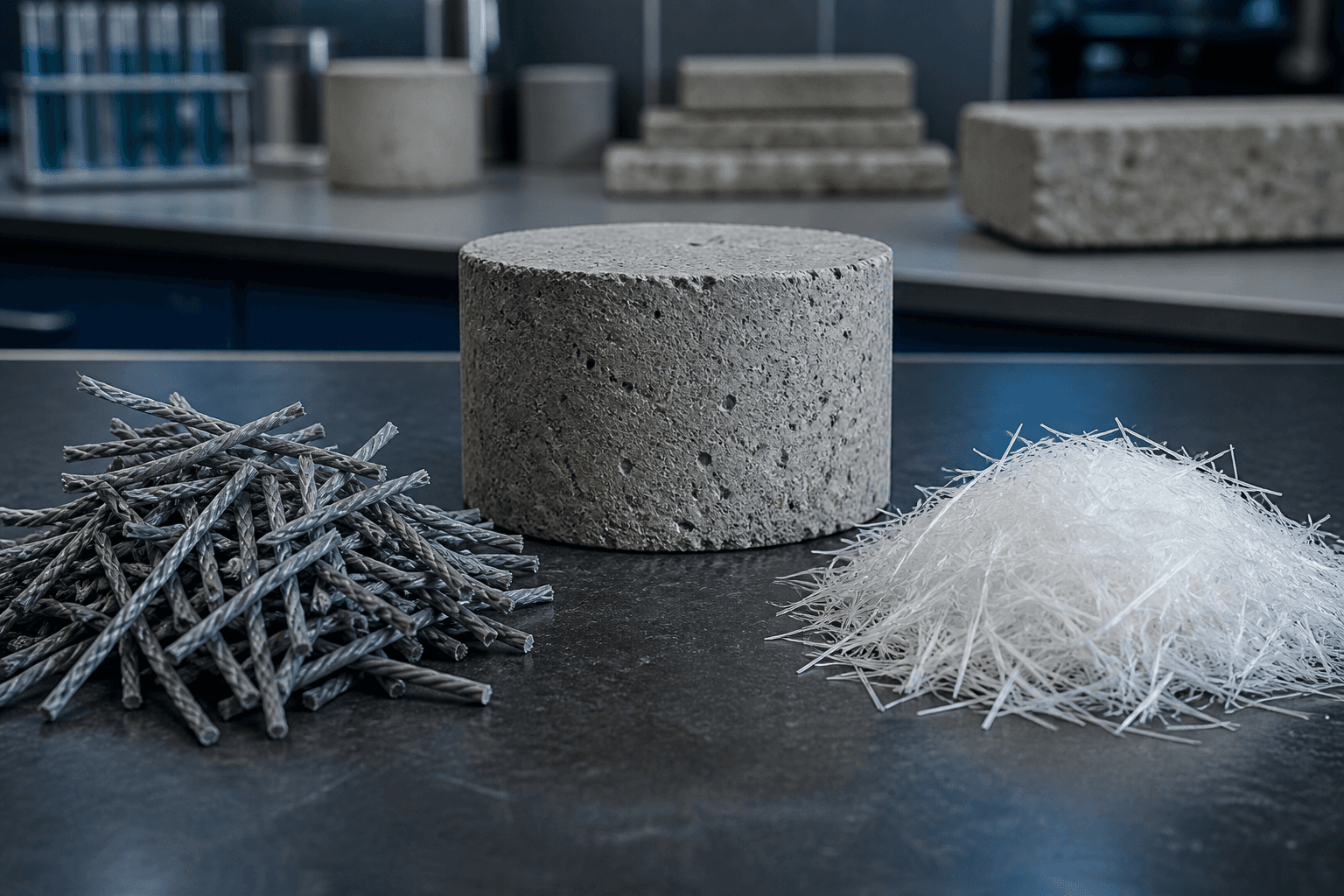
Differences Between Macro and Micro Synthetic Fibers
One of the most common mistakes in synthetic fiber reinforcement selection is assuming that macro and micro fibers perform the same function. Both are commonly polypropylene-based and added to concrete, but they differ in size, dosage, the age of concrete at which they act and the performance they provide.
What Is Micro Synthetic Fiber?
Micro synthetic fibers are very fine polypropylene filaments typically 6–19 mm long. They support the control of plastic shrinkage cracks that can develop while concrete is still fresh due to surface moisture loss and volume change. Used at low dosage, they create a uniform network of millions of fibers throughout the mix.
Microfibers may support mix integrity, help reduce bleeding and segregation, and contribute to a more consistent surface when combined with proper finishing. However, microfiber is not structural reinforcement. It does not replace steel mesh, reinforcing bars or an engineered macro fiber system.
What Is Macro Synthetic Fiber?
Macro synthetic fibers are thicker and longer, with common products ranging from approximately 30–60 mm and dosages measured in kilograms. They are used to support post-crack behavior, energy absorption, impact resistance and fatigue performance in hardened concrete.
Industrial floors, external yards, warehouses, logistics centers, tunnels, shotcrete and precast elements are common macro fiber applications. When considered as an alternative to steel mesh or steel fibers, ground conditions, slab design, loading and joint layout must be evaluated through engineering calculations.
Key Differences
- Function: Microfiber supports shrinkage crack control in fresh concrete; macro fiber supports post-crack behavior in hardened concrete.
- Size: Microfibers are fine and short, while macro fibers are thicker and longer.
- Dosage: Microfiber dosage is measured in grams; macro fiber dosage is measured in kilograms.
- Structural role: Microfiber is not structural reinforcement. Macro fiber may be considered within a structural reinforcement system only with appropriate design and approval.
When Is a Hybrid System Appropriate?
Micro and macro fibers may be combined where fresh concrete crack control and surface quality are important alongside heavy forklift or vehicle traffic. In a hybrid system the products do not replace one another; they complement the concrete at different ages and perform different functions.
How Should the Right Fiber Be Selected?
Selection should not be based only on floor area or concrete class. Ground bearing capacity, slab thickness, concrete strength, operational use, rack and machinery loads, traffic, joint spacing and placement method should be evaluated together. The PP Fiber technical team reviews project data and helps compare appropriate fiber types and dosage alternatives.